EU Battery Passport: Everything You Need to Know
The EU Battery Regulation, February 2027 deadlines, mandatory data fields, and how to deliver compliant battery passports.
Key points
- **Portable battery** — sealed, weighs ≤5 kg, not specifically designed for industrial use, and not an LMT, EV or SLI battery. *No passport required.*
- **18V / 20V cordless drill pack (~0.5–0.8 kg, 60–120 Wh)** → Portable battery. Sold to consumers, <5 kg, dual-use. **No battery passport.** Still needs CE marking, removability/replaceability compliance (Article 11), EPR registration in each Member State, and from August 2030 a carbon footprint declaration for rechargeable portables.
- **Removability and replaceability (Article 11)** — from 18 February 2027, portable batteries incorporated into appliances must be readily removable and replaceable by the end user, with limited exceptions (wet environments, safety-critical, continuous-use professional tools). This is the single biggest design-impact item for appliance OEMs.
- Unique identifier for each battery unit (not just model-level)
Contents
The EU Battery Regulation: A New Era of Accountability
The EU Battery Regulation (EU 2023/1542) represents a landmark piece of legislation that fundamentally reshapes how batteries are manufactured, sold, used, and recycled within the European market. At its centre is the requirement for a digital battery passport — a comprehensive digital record that accompanies every industrial and electric vehicle battery throughout its lifecycle.
This regulation is the first EU legislation to mandate Digital Product Passports for a specific product category, making it the de facto pilot for the broader ESPR framework. How the battery passport is implemented will set precedents for every product category that follows.
- Adopted in August 2023, with phased implementation through 2031
- Applies to all batteries placed on the EU market, regardless of origin
- Covers portable, industrial, EV, LMT (light means of transport), and SLI batteries
- Printed Article 13 label mandatory from 18 August 2026 on every battery
- QR code (Article 13(6)) and full battery passport (Article 77, for EV / LMT / industrial >2 kWh) both mandatory from 18 February 2027
Note
The EU Battery Regulation is distinct from the ESPR — it was adopted earlier and operates on its own timeline, though the DPP requirements are designed to be interoperable with the broader ESPR framework.
The five battery categories — and which ones actually need a passport
One of the most common questions we get is "does my product need a battery passport?" — and the answer almost always comes down to which of the five Article 3 categories your battery falls into. The regulation replaced the old three-way split (portable / industrial / automotive) with five categories, and the digital battery passport obligation under Article 77 only applies to three of them.
Battery passport required (from 18 February 2027): LMT batteries, industrial batteries with capacity above 2 kWh, and EV batteries. Battery passport NOT required: portable batteries (including portable batteries of general use) and SLI batteries — although every other duty under the regulation (CE marking, labelling, removability, EPR registration, hazardous-substance limits, and from 2030 a carbon footprint declaration for rechargeable portables) still applies.
For a tabbed, plain-English walkthrough of Article 11 removability, the 2026 labelling QR, the 2030 carbon footprint wall and what to do on Monday morning, see our dedicated EU Battery Regulation practical guide.
The definitions, taken directly from Article 3 of Regulation (EU) 2023/1542:
- Portable battery — sealed, weighs ≤5 kg, not specifically designed for industrial use, and not an LMT, EV or SLI battery. *No passport required.*
- Portable battery of general use — a sub-class covering interoperable consumer formats: AAAA, AAA, AA, C, D, 9V (PP3), 4.5V (3R12), A23, button cell. *No passport required.*
- LMT (Light Means of Transport) battery — provides traction to wheeled vehicles powered by motor alone or motor + human power, ≤25 kg. E-bikes, e-scooters, e-mopeds. *Passport required, no kWh threshold.*
- Industrial battery — specifically designed for industrial use, OR any battery >5 kg that isn't LMT/EV/SLI. Includes stationary storage, telecoms backup, agricultural, off-road and rail traction. *Passport required if capacity >2 kWh.*
- SLI (Starting, Lighting, Ignition) battery — the 12V lead-acid (or Li) battery that starts an ICE vehicle. *No passport required.*
- EV battery — provides traction to type-approved vehicles of categories M, N, O (cars, vans, trucks, buses, trailers) or category L if >25 kg (heavy motorcycles). *Passport required, no kWh threshold.*
Important
The 2 kWh threshold only applies to **industrial** batteries. An e-scooter pack of 0.4 kWh still needs a passport because it is an LMT battery, and an EV pack of 1.5 kWh in a plug-in hybrid still needs a passport because it is an EV battery.
Worked examples: cordless drills, vacuum cleaners, e-bikes and home batteries
The grey area — and the one we get asked about most — is custom battery packs in household power tools and appliances: cordless drills, impact drivers, stick vacuums, robot lawnmowers, garden blowers, electric toothbrushes. These are clearly not AA cells, but they're also not "industrial" in any normal sense. So which bucket?
The answer comes from the European WEEE Register Network (EWRN) guidance on category allocation (April 2025), which clarifies the "specifically designed for industrial use" test: *"Batteries cannot be considered as specifically designed for industrial use if they normally arise or are normally used in private households. This also includes batteries that are built into so-called 'dual use' electrical appliances."* In other words: if the same product is sold to consumers in DIY stores, the pack is a portable battery — even if a professional tradesperson also buys it.
Here is how the most common asks land in practice:
- 18V / 20V cordless drill pack (~0.5–0.8 kg, 60–120 Wh) → Portable battery. Sold to consumers, <5 kg, dual-use. No battery passport. Still needs CE marking, removability/replaceability compliance (Article 11), EPR registration in each Member State, and from August 2030 a carbon footprint declaration for rechargeable portables.
- Cordless stick vacuum / robot vacuum pack (~0.4–1.2 kg) → Portable battery. No passport. Same obligations as the drill pack.
- Cordless lawnmower or garden blower pack (often 2–4 kg, up to ~1 kWh) → Still portable as long as it is ≤5 kg and sold for household use. No passport.
- Professional-grade backpack battery for landscaping crews (>5 kg) → Industrial battery by the >5 kg rule. Passport required only if >2 kWh (most are 1–1.5 kWh, so often no passport — but full industrial-battery labelling and due-diligence rules apply).
- E-bike or e-scooter pack (typically 0.3–0.7 kWh, 2–4 kg) → LMT battery. Passport required from 18 Feb 2027 regardless of capacity.
- Home energy storage (Powerwall-class, 5–15 kWh) → Industrial battery (stationary storage sub-class). Passport required — well above the 2 kWh threshold.
- Telecoms / data-centre UPS string (>2 kWh) → Industrial battery. Passport required.
- Mobility scooter / e-wheelchair pack → LMT category in most readings (motor-only or motor+manual traction, ≤25 kg). Passport required.
- 12V car starter battery → SLI battery. No passport — but carbon footprint declaration and recycled-content rules still apply on the SLI timeline.
- EV traction pack (any plug-in car, van, truck, bus, or motorcycle >25 kg) → EV battery. Passport required from 18 Feb 2027, no kWh threshold.
Tip
Quick decision rule for power-tool and appliance OEMs: if the host product is sold through consumer retail channels (Amazon, B&Q, Bauhaus, Leroy Merlin, Screwfix's consumer SKUs) and the pack is ≤5 kg, you almost certainly have a **portable battery** and do **not** need a digital battery passport — but you do need the rest of the Battery Regulation compliance stack. If you sell the same chemistry in a >5 kg backpack format to professional fleets, that SKU flips into the industrial category and the 2 kWh test then decides whether a passport applies.
What portable-battery products still owe under the Battery Regulation
It is worth being explicit: "no battery passport" is not "no obligations." The portable category carries a substantial set of duties that already apply or activate before 2030, and that catch every cordless drill, vacuum and toothbrush brand selling into the EU.
- Removability and replaceability (Article 11) — from 18 February 2027, portable batteries incorporated into appliances must be readily removable and replaceable by the end user, with limited exceptions (wet environments, safety-critical, continuous-use professional tools). This is the single biggest design-impact item for appliance OEMs.
- Restrictions on hazardous substances (Article 6, Annex I) — mercury and cadmium limits, with cadmium phase-out for portable batteries in cordless power tools deferred to 31 December 2027.
- Labelling and information (Articles 13 and 77) — the printed label (manufacturer, category, capacity, chemistry, hazardous substances, crossed-out wheelie bin symbol) becomes mandatory on 18 August 2026 under Article 13(1)–(5); the QR code (data carrier) becomes mandatory on 18 February 2027 under Article 13(6). Both apply to every battery, portable included.
- EPR registration and take-back (Articles 54–58) — register as a producer in every Member State you sell into, fund collection and recycling, hit minimum collection-rate targets (63% by end of 2027, 73% by end of 2030 for portables).
- Carbon footprint declaration for rechargeable portables — phased in from 18 August 2030 under the same PEFCR methodology as industrial and EV batteries.
- CE marking and conformity assessment (Articles 17–20) — covering safety, performance and durability requirements set out in Annexes III–IV.
Note
If you are a cordless-tool, garden-tool or small-appliance brand, the practical 2025–2027 priorities are removability/replaceability redesign, EPR registration in every selling Member State, the printed label (18 Aug 2026) and the QR (18 Feb 2027). The passport question is a 2027+ conversation only if you also sell professional >5 kg, >2 kWh packs.
What Is a Battery Passport?
A battery passport is a digital twin of a physical battery that contains detailed information about its composition, manufacturing history, performance characteristics, and end-of-life handling requirements. Unlike a simple product datasheet, the battery passport is a living document — updated throughout the battery's service life with performance degradation data, maintenance records, and eventually recycling outcomes.
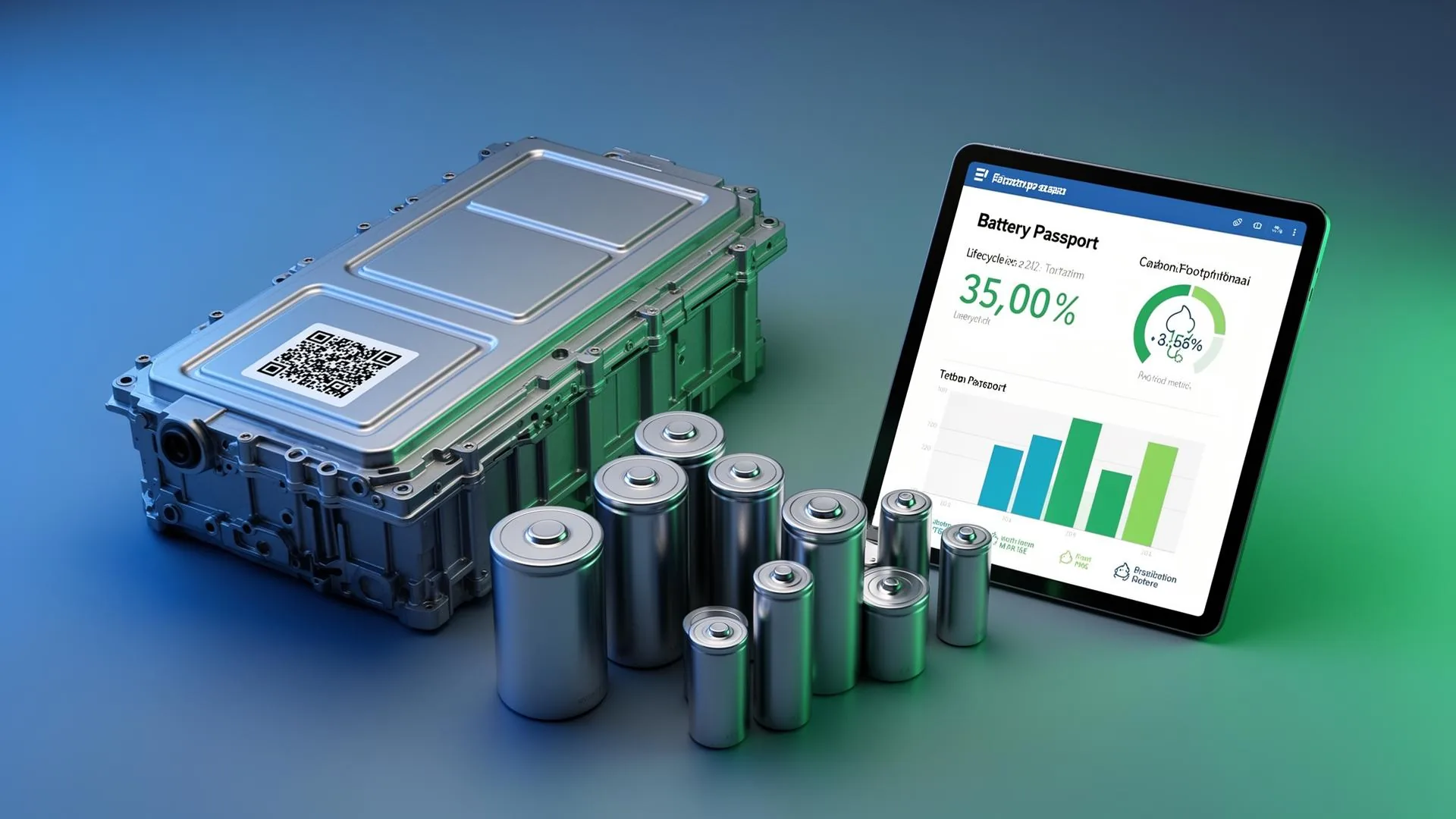
The passport must be accessible via a data carrier (QR code or equivalent) affixed to the battery and linked to a globally unique identifier. It must be machine-readable and accessible to all relevant actors in the value chain: manufacturers, vehicle OEMs, service providers, second-life operators, and recyclers.
- Unique identifier for each battery unit (not just model-level)
- Accessible via QR code or equivalent data carrier on the battery
- Machine-readable and human-readable formats required
- Data persists for the battery's entire lifecycle including second-life applications
Mandatory Data Fields for Battery Passports
The EU Battery Regulation specifies an extensive list of data attributes that must be included in the battery passport. These fields cover the battery's identity, composition, performance, and sustainability credentials. The level of detail required is significantly more granular than typical product documentation.
Manufacturers should note that many of these data fields require information from upstream suppliers — cathode material origins, mineral sourcing declarations, and carbon footprint calculations spanning the entire supply chain.
- Battery identification: manufacturer, model, GTIN, serial number, date of manufacture
- Chemistry and composition: cathode/anode materials, electrolyte type, hazardous substances
- Performance data: rated capacity, voltage, cycle life, energy density, round-trip efficiency
- Carbon footprint: lifecycle CO₂ equivalent per kWh, calculated per ISO 14067
- Recycled content: percentages of cobalt, lithium, nickel, and lead from recycled sources
- Due diligence: supply chain due diligence documentation for raw materials
- State of health: capacity fade, impedance increase, remaining useful life estimates
- End-of-life: collection and recycling information, safety instructions for dismantling
Important
The carbon footprint declaration becomes mandatory before the battery passport itself — from February 2025 for EV batteries. Brands must begin carbon accounting now if they haven't already.
Compliance Timeline: Key Dates for Battery Manufacturers
The EU Battery Regulation follows a staggered implementation schedule, with different requirements activating at different dates. Understanding this timeline is essential for resource planning and supplier engagement.
Notably, the regulation introduces requirements progressively — carbon footprint declarations first, then due diligence obligations, then the full battery passport — giving manufacturers incremental milestones rather than a single compliance cliff.
- August 2024 — Regulation fully applicable for most provisions
- February 2025 — Carbon footprint declaration required for EV batteries
- August 2025 — Due diligence policies for raw material supply chains
- 18 August 2026 — Printed Article 13(1)–(5) label mandatory on every battery
- 18 February 2027 — QR code (Article 13(6)) mandatory on every battery; full battery passport (Article 77) mandatory for EV, LMT and industrial >2 kWh
- August 2027 — Carbon footprint performance classes introduced
- August 2028 — Maximum carbon footprint thresholds enforced
- 2031 — Mandatory recycled content minimum percentages
Supply Chain Due Diligence Requirements
The Battery Regulation introduces mandatory supply chain due diligence obligations aligned with international standards (OECD Due Diligence Guidance for Responsible Supply Chains of Minerals). This is particularly significant given the well-documented concerns around cobalt mining in the Democratic Republic of Congo and lithium extraction in South America.
Economic operators must establish due diligence policies, identify and assess risks in their supply chains, implement risk mitigation strategies, and report publicly on their findings. This applies not just to battery cell manufacturers but to any company placing batteries on the EU market — including vehicle manufacturers and electronics brands.
- Due diligence policy covering cobalt, lithium, nickel, natural graphite, and manganese
- Risk identification across the full mineral supply chain
- Third-party audits of due diligence systems
- Public reporting on supply chain risks and mitigation measures
- Applies to all economic operators, not just direct mineral purchasers
Carbon Footprint Calculation and Reporting
Battery carbon footprint declarations are calculated on a lifecycle basis, covering raw material extraction, processing, cell manufacturing, battery assembly, and transportation. The methodology follows Product Environmental Footprint Category Rules (PEFCR) specific to batteries.
The regulation introduces a three-phase approach: first, mandatory carbon footprint declarations (transparency); second, performance classes (comparability); third, maximum thresholds (enforcement). This progression gives the market time to respond while steadily raising the bar.
- Lifecycle assessment covering cradle-to-gate emissions
- Methodology aligned with ISO 14067 and EU PEFCR for batteries
- Performance classes (A-E) enabling cross-battery comparison
- Maximum carbon footprint thresholds phased in from 2028
- Third-party verified calculations required for market access
Tip
SmartLinks can host and dynamically display carbon footprint data within your battery passport, including performance class labels and comparison tools for consumers and B2B buyers.
Second-Life Batteries and State of Health Tracking
A key innovation of the Battery Regulation is its recognition that batteries retain significant value after their primary application. An EV battery that has degraded below automotive thresholds may still be perfectly suitable for stationary energy storage. The battery passport facilitates this second-life market by maintaining continuous state of health (SoH) records.
The passport must include real-time or regularly updated SoH data — capacity fade, impedance changes, charge cycle count — enabling second-life operators to assess a battery's remaining useful life without physical testing. This transparency dramatically reduces the risk and cost of repurposing batteries.
- State of health data updated throughout the battery's service life
- Capacity fade tracking: remaining percentage of original rated capacity
- Cycle count and charge/discharge history
- Safety incident records and maintenance history
- Facilitates valuation for second-life applications
Implementing Battery Passports with Connected Packaging
Connected packaging technologies — particularly QR codes and NFC tags — provide the ideal delivery mechanism for battery passport data. A QR code printed on the battery label or an NFC tag embedded in the casing gives instant access to the full digital passport via a smartphone scan.
SmartLinks enables battery manufacturers and OEMs to deploy compliant battery passports rapidly. Our platform manages the unique identifiers, hosts the structured data, and presents it through audience-specific interfaces: consumers see safety and recycling information, service technicians access performance diagnostics, and regulators retrieve compliance documentation.
- Durable QR codes rated for industrial environments (UV, heat, chemical resistance)
- NFC tags with tamper-detection for authenticity verification
- Dynamic data updates: push state of health changes without altering the physical label
- Regulatory-grade data hosting with 10+ year retention guarantees
- Multi-stakeholder access: different views for consumers, service centres, and authorities
- API integration with battery management systems (BMS) for automated SoH reporting
Tip
SmartLinks battery passport solutions integrate directly with existing Battery Management Systems via API, enabling automated state of health updates without manual data entry.
The reference architecture: JRC, CIRPASS-2 and Catena-X
The Battery Regulation deliberately stops short of specifying technology. Instead, three projects are converging on the de facto reference architecture every other DPP regime will inherit.
The Joint Research Centre (JRC) publishes the technical guidance documents that translate the regulation into implementable requirements — including the data model, the carbon footprint calculation rules, and the conformity assessment procedures. CIRPASS-2 is piloting the cross-product DPP infrastructure across batteries, textiles, electronics, and tyres. Catena-X is the automotive-industry data space that most EV-battery passports will physically run on, using the IDS (International Data Spaces) trust framework for sovereign data exchange between OEMs, cell makers, and recyclers.
For a battery brand, the practical implication is that your passport must be interoperable with Catena-X's data model even if you don't join the consortium — your customers (the vehicle OEMs) will require it.
- JRC technical guidance — the binding interpretation layer for Articles 6 (carbon footprint), 7 (recycled content), and 77 (passport)
- CIRPASS-2 — Horizon Europe pilots producing the reference data model the delegated acts cite
- Catena-X — automotive data space using Eclipse Dataspace Connector (EDC) for sovereign data exchange
- IDS / Gaia-X — the underlying European data-sovereignty frameworks Catena-X builds on
- Global Battery Alliance Battery Passport — the industry-led pilot whose Proof of Concept v1.0 (2023) shaped the EU data fields
Note
If your customer is a European OEM (VW Group, Stellantis, BMW, Renault, Volvo), specifying Catena-X EDC compatibility in your passport platform RFP is now table stakes — most have published supplier mandates requiring it from model-year 2027.
Worked example: carbon footprint declaration for a 75 kWh EV pack
The carbon footprint declaration (CFP) is the first data field that becomes mandatory — February 2025 for EV batteries — and it's the one most likely to surface supply-chain data gaps. Here is the rough shape of a compliant declaration for a typical 75 kWh NMC811 pack.
The CFP is reported in kg CO₂-eq per kWh of total energy delivered over the battery's expected service life, calculated cradle-to-gate per the EU PEFCR for batteries. For a 75 kWh NMC pack manufactured in 2025, a representative figure is 60–90 kg CO₂-eq/kWh, with raw-material extraction (cathode minerals especially) accounting for roughly half of total emissions, cell manufacturing 25–35% (heavily dependent on the electricity mix at the gigafactory), and pack assembly and logistics making up the remainder. From August 2027, packs must additionally declare their CFP performance class (A–E); from August 2028, packs in class E will be barred from the EU market entirely.
- Functional unit — 1 kWh of total energy delivered over the battery's service life
- System boundary — cradle-to-gate (raw materials → cell → pack → factory gate)
- Typical 2025 figures for NMC811 EV pack — 60–90 kg CO₂-eq/kWh
- Cathode minerals — typically 40–55% of total cradle-to-gate emissions
- Cell manufacturing energy — 25–35%, dominated by the gigafactory electricity mix
- Verification — third-party verified to ISO 14067 and the EU PEFCR for batteries
Important
From August 2028, Class-E batteries lose EU market access. Brands sourcing cells from coal-heavy grids without renewable PPAs in place should be modelling this cliff into their 2027 supplier decisions now.
Sources and primary references
Bookmark the regulatory text and JRC technical guidance directly — third-party interpretation lags the source by months as delegated acts publish.
- Regulation (EU) 2023/1542 — the Battery Regulation in full
- JRC battery technical guidance — methodology for carbon footprint declarations
- CIRPASS-2 — pilot deliverables for batteries, textiles, electronics, tyres
- Catena-X — automotive data space and reference architecture
- Global Battery Alliance Battery Passport — Proof of Concept v1.0
- Eclipse Dataspace Connector (EDC) — the open-source connector behind Catena-X data exchange